
What if the most powerful spiritual guidance came not from ivory towers, but from the weathered hands of those who transformed unimaginable suffering into boundless compassion? Meet Vovó Maria Conga, a figure whose journey from enslaved child to legendary freedom fighter to beloved Preta Velha challenges everything we think we know about strength, wisdom, and spiritual power.
In the sacred spaces of Umbanda temples across Brazil, when the drums call and the energy shifts, practitioners know they might encounter one of the most revered Pretas Velhas of all time. Vovó Maria Conga doesn't just offer spiritual guidance, she embodies the transformation of trauma into triumph, of bondage into liberation, of individual pain into collective healing.
From Chains to Quilombos: A Life of Revolutionary Spirit
The year was 1792 when Maria was born on African soil, her destiny intertwined with the brutal machinery of the Atlantic slave trade. At just eight years old, she was torn from everything familiar, packed into the suffocating darkness of a slave ship alongside her parents and siblings. The child who would become Vovó Maria Conga experienced firsthand the dehumanizing horror that millions of Africans endured during the Middle Passage.
Landing in Salvador, Bahia, she was given the Christian name Maria da Conceição, a common practice designed to erase African identity and impose European religious frameworks. But names have power only when we give them power, and this young girl carried within her something that no slaver could touch: an unbreakable spirit and an innate understanding of justice.

At eighteen, Maria faced another traumatic separation when she was sold to a German slave owner and transported to Magé in Rio de Janeiro. Many would have been crushed by such repeated upheavals, but Maria was gathering strength, observing, learning, and preparing for what would become her life's mission.
The pivotal moment came when she turned thirty-five. Rather than accept the limited freedom offered by manumission papers, Maria made a choice that would echo through history: she walked away from the plantation and dedicated her life to liberating her people. This wasn't just personal freedom, it was a declaration of war against the entire system of oppression.
The Quilombo Builder: Creating Communities of Resistance
What makes Vovó Maria Conga extraordinary isn't just that she escaped, it's what she did with her freedom. In the dense forests and hidden valleys of Magé, she founded a quilombo, one of the many communities of formerly enslaved and fugitive Africans that dotted the Brazilian landscape like beacons of hope.
But Maria didn't stop there. She became a serial liberator, establishing multiple quilombos throughout the Baixada Fluminense region. Think about the courage this required: she was essentially building an underground railroad system, creating safe havens for people fleeing bondage, all while evading constant pursuit by slave hunters and colonial authorities.
Her skills extended far beyond military strategy. Maria was a midwife, bringing new life into the world with gentle hands that had known brutality. She was an herbalist, using traditional African plant medicine to heal bodies and souls. Most importantly, she was a fierce defender of Black self-esteem at a time when the entire colonial system was designed to crush African identity and dignity.

For nearly seventy years, Maria Conga remained free, always one step ahead of those who sought to recapture her. She died in 1895 at the remarkable age of 103, never reunited with the family torn from her in childhood, but having created countless new families among those she liberated.
The Spiritual Transformation: From Historical Figure to Preta Velha
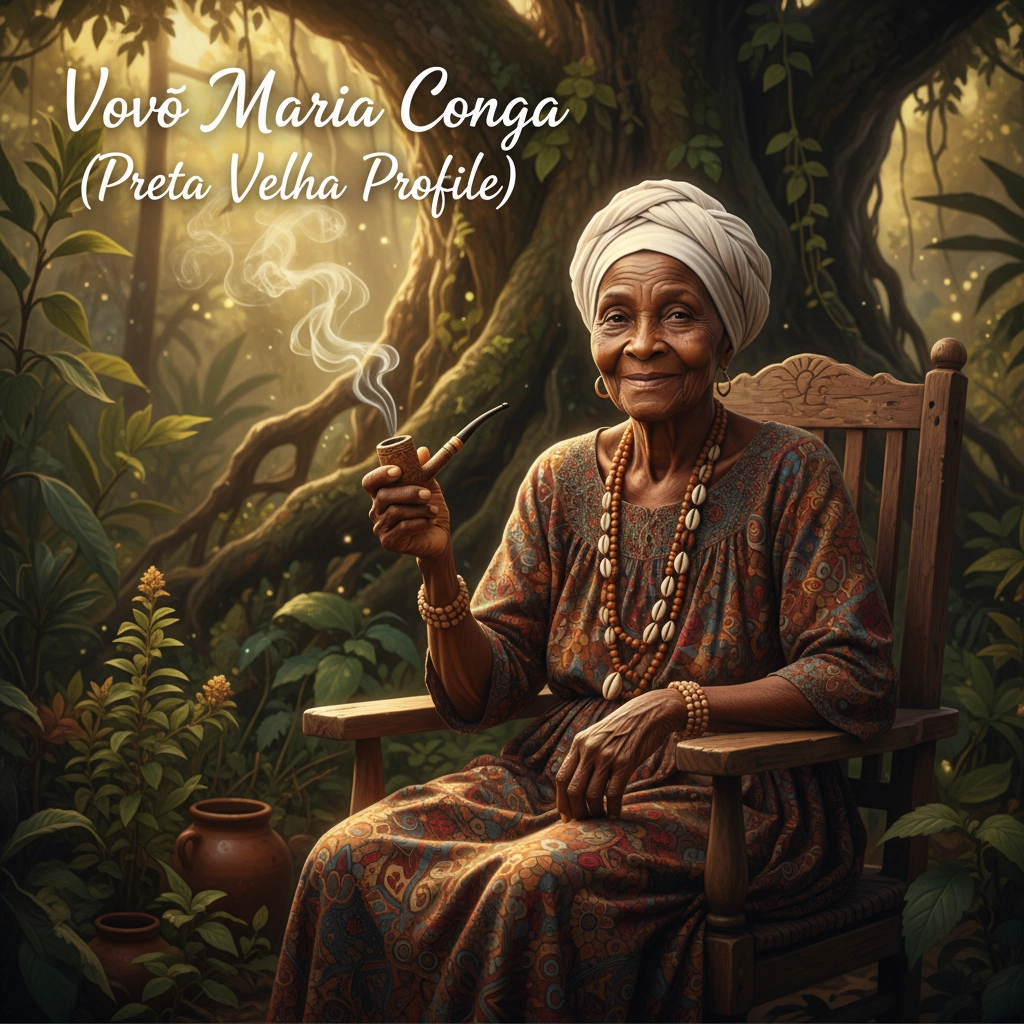
Death is not the end in Afro-Brazilian spiritual traditions, it's a transformation. When Maria Conga passed from the physical realm, her spirit evolved into something even more powerful: a Preta Velha, one of the beloved elderly spiritual entities who work within Umbanda to guide and heal the living.
As Vovó Maria Conga, she embodies the archetypal wisdom of the Pretos Velhos, the spiritual falange descended from enslaved Africans who now serve as intermediaries between the divine realm and human suffering. Her presence in Umbanda temples brings a unique combination of revolutionary fire and grandmotherly compassion, street-smart practicality and profound spiritual insight.
What sets her apart from other Pretas Velhas is her lived experience as a freedom fighter. While many Pretos Velhos focus on patience and endurance, Vovó Maria Conga brings an additional dimension: the understanding that sometimes love requires action, that true spirituality must confront injustice, and that healing often demands courage.
The Spiritual Characteristics: Wisdom Forged in Fire
When Vovó Maria Conga manifests through mediums in Umbanda ceremonies, devotees encounter a spiritual presence marked by several distinctive characteristics. Her energy carries the weight of lived experience, this is not theoretical wisdom but understanding forged in the crucible of real struggle.
She embodies humility without passivity. Yes, she demonstrates the gentle patience expected of a grandmother figure, but there's steel beneath the softness. Her serenity comes not from never having faced challenges, but from having faced the worst humanity has to offer and emerged not bitter, but compassionate.

Vovó Maria Conga's approach to spiritual guidance reflects her background as both nurturer and revolutionary. She understands that sometimes the most loving thing you can do is help someone find their own strength to change their circumstances. She doesn't just comfort the afflicted: she afflicts the comfortable, challenging devotees to examine their own complicity in systems of oppression.
Her teachings center on the Law of Dharma: the understanding of cause and effect, action and consequence. Having lived through the ultimate expression of human injustice, she guides people to understand how their choices ripple through time and space, affecting not just themselves but entire communities.
Working with Vovó Maria Conga: Practical Spiritual Guidance
Devotees who seek guidance from Vovó Maria Conga often come with problems that require both spiritual insight and practical action. She's particularly powerful for those facing oppression, discrimination, or situations where they must choose between safety and justice.
Her consultations tend to blend mystical wisdom with revolutionary pragmatism. She might prescribe specific prayers or spiritual cleansings, but she's equally likely to encourage concrete steps toward empowerment: education, community organizing, or simply finding the courage to speak truth to power.
Many practitioners report that working with Vovó Maria Conga helps them understand the difference between martyrdom and meaningful sacrifice. Her own life demonstrates how to fight injustice without losing one's humanity, how to resist oppression without becoming oppressive oneself.
She's especially helpful for those dealing with ancestral trauma, family separation, or the psychological wounds left by systemic racism. Having lived through the ultimate family separation herself, she understands the deep soul wounds that such experiences create, and she offers healing that addresses both the spiritual and psychological dimensions of trauma.
The Enduring Legacy: Recognition and Reverence
In 1988, nearly a century after her death, the municipality of Magé officially proclaimed Maria Conga as the city's heroine during the centennial celebration of the Lei Áurea (Golden Law) that abolished slavery in Brazil. This recognition represents more than historical acknowledgment: it's an understanding that her resistance created ripples that are still felt today.
But her most powerful legacy lives in the thousands of Umbanda temples where her spirit continues to work. Every time a devotee finds the courage to leave an abusive situation, every time someone chooses justice over safety, every time a community comes together to protect its most vulnerable members, Vovó Maria Conga's revolutionary spirit lives on.

Her story challenges comfortable assumptions about spiritual practice. In a world where spirituality is often packaged as personal peace and individual enlightenment, Vovó Maria Conga reminds us that true spiritual development sometimes requires us to disturb the peace, to fight for collective liberation, to understand that personal healing is incomplete without social justice.
Connecting with Her Energy Today
Modern devotees don't need to travel to Brazilian temples to connect with Vovó Maria Conga's energy. Her spirit responds to sincere calls for guidance, especially from those facing their own moments of choice between compliance and resistance.
Light a white candle, offer a simple prayer for wisdom and courage, and ask her to help you understand the difference between authentic spirituality and spiritual bypassing. She'll help you see where your own liberation connects to the freedom of others, where your healing contributes to collective transformation.
The technology may be different, but the fundamental questions remain the same: Will you choose comfort or justice? Will you prioritize personal peace over collective liberation? Will you use your privileges to build bridges or walls?
Vovó Maria Conga's presence in our modern world reminds us that spiritual evolution isn't always gentle. Sometimes it requires us to break chains: both visible and invisible. Sometimes the most sacred act is the revolutionary one. The grandmother who fought for seventy years and died free continues to teach us that true spirituality serves not just the soul, but justice itself.